
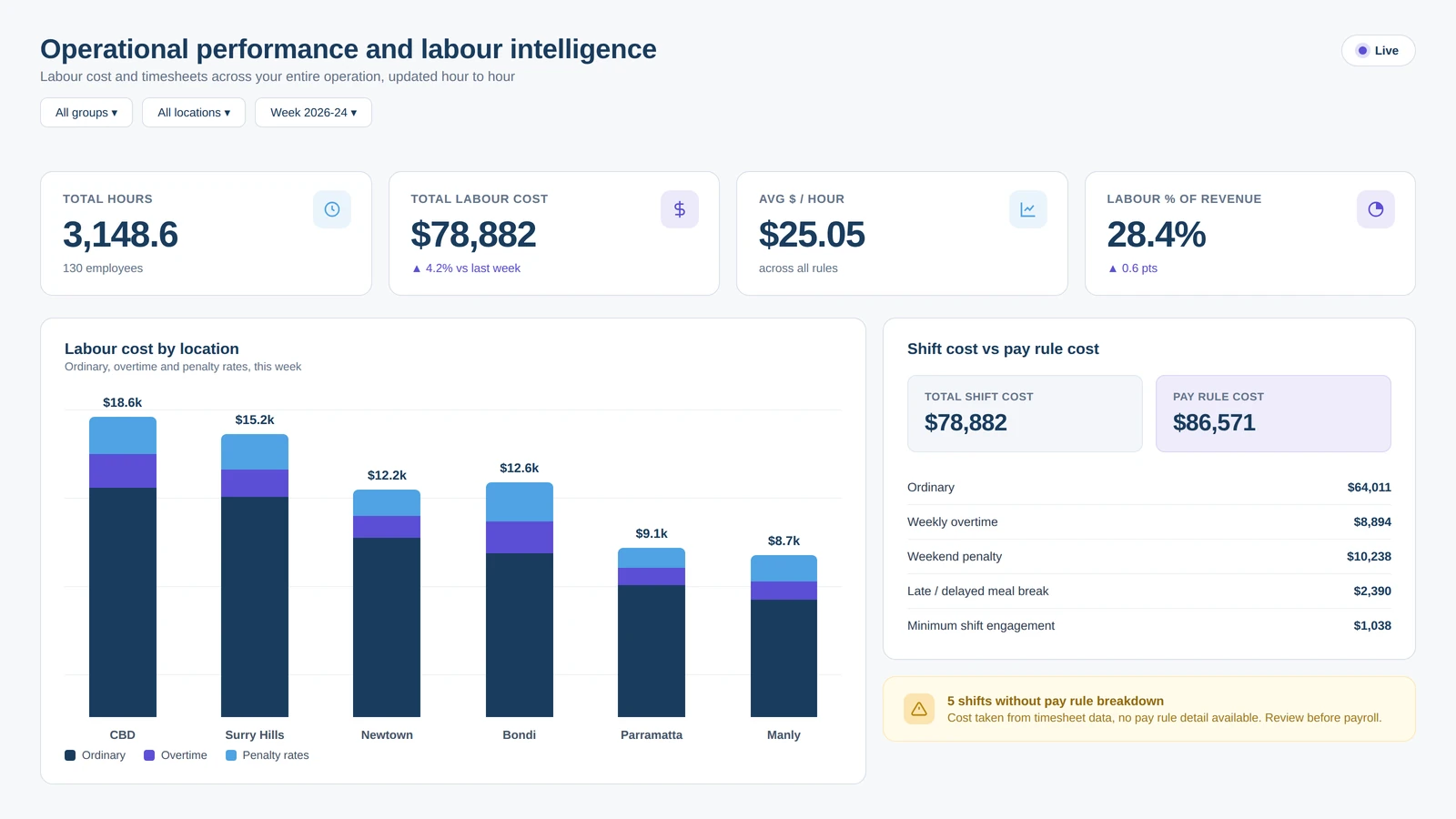
What is Operational Business Intelligence?
Operational Business Intelligence (OBI) is the practice of using live data from day-to-day operations to guide decisions as they happen. Instead of waiting for a monthly management report, OBI gives managers and owners a current view of sales, costs, inventory, labour and supplier performance – often updated within minutes of a transaction.
For Australian SMEs, where margins are tight and market conditions can shift quickly, operational business intelligence turns raw operational data into an early-warning system and a decision-making compass.
Live data, not stale reports – OBI connects to your operational systems and refreshes metrics as transactions happen – sales, invoices, inventory, labour and supplier prices update continuously rather than overnight or at month end.
Actionable by front-line teams – dashboards and alerts are designed for venue managers, production supervisors and operations leaders, not just analysts. They see what needs attention and can act before a small issue becomes an expensive problem.
Embedded in daily workflows – OBI surfaces insights inside purchasing, receipting, invoice approval and rostering workflows so decisions are made in context, not in a separate reporting tool.
OBI vs traditional historical BI
Traditional business intelligence is valuable for spotting long-term trends, but it looks backwards. Reports are typically built from data warehouses refreshed daily, weekly or monthly. By the time a problem appears, the damage is already done.
| Traditional BI | Operational BI |
|---|---|
| Historical, batch-based reports | Live or near-real-time metrics |
| Analyst-led, centralised team | Manager-led, distributed decision making |
| Answers “what happened last month?” | Answers “what is happening right now?” |
| Separate reporting tools | Embedded in operational workflows |
| Delayed insight | Immediate alerts and recommended actions |
Why Australian SMEs need OBI
Australian small and medium businesses operate in high-cost, competitive environments. Wage pressure, supply chain volatility and changing customer expectations mean that waiting until month end to spot a margin problem is no longer good enough.
Operational business intelligence lets an SME owner or operations manager see:
- Which products or dishes are profitable today, not last quarter.
- Whether supplier invoice prices match contracted rates before approval.
- How labour cost and productivity compare to revenue, hour by hour.
- Where inventory variances are emerging before stocktake.
- Which sites, shifts or production runs are drifting off plan.
Hospitality: protect margins in real time
A restaurant group uses OBI to connect POS sales, supplier invoices, recipe costs and rostering data. When the price of a key ingredient rises, recipe margins update automatically. The group can adjust menus, negotiate with suppliers or change specials before the next service – not after the monthly P&L arrives.
Venue managers also see labour cost as a percentage of revenue by shift, so they can adjust rosters before overtime or under-staffing erodes profitability.
Manufacturing: control production costs
A manufacturer links supplier invoices, bills of materials, production output and inventory movements. OBI highlights when raw material costs push a finished good below target margin, or when a production run uses more material than expected.
Production supervisors act on the same day, investigating machine settings, yield issues or supplier quality rather than discovering the problem weeks later.
What to look for in an OBI platform
Not every analytics tool delivers true operational business intelligence. When evaluating a platform, Australian SMEs should prioritise capabilities that close the gap between data and action:
Pre-built operational connectors – look for integrations with your accounting, ERP, POS, workforce and supplier systems so data flows automatically without manual extracts.
Three-way matching and spend control – the platform should read supplier invoices, match them to purchase orders and goods receipts, and flag price or quantity variances before payment.
Recipe, bill of materials and inventory costing – for hospitality and manufacturing, cost intelligence must update automatically as supplier prices change, so margins are always current.
Role-based dashboards and alerts – managers need focused views of the metrics they control, with alerts when KPIs drift outside acceptable ranges.
Fast, cloud-native performance – Australian SMEs operate at pace; the platform must respond instantly on desktop and mobile, not keep users waiting for reports to refresh.
Getting started with OBI
Start with one high-impact operational question. For hospitality, it might be “what is my actual plate cost today?” For manufacturing, it might be “which production runs are outside my target cost?” Connect the data sources that answer that question first, prove the value, then expand.
The goal is not more dashboards. It is faster, more confident decisions made by the people who run the operation every day.
Want to see operational business intelligence in action?
SinoraIQ gives Australian SMEs real-time visibility across accounts payable, purchasing, costs, inventory and operational performance.